

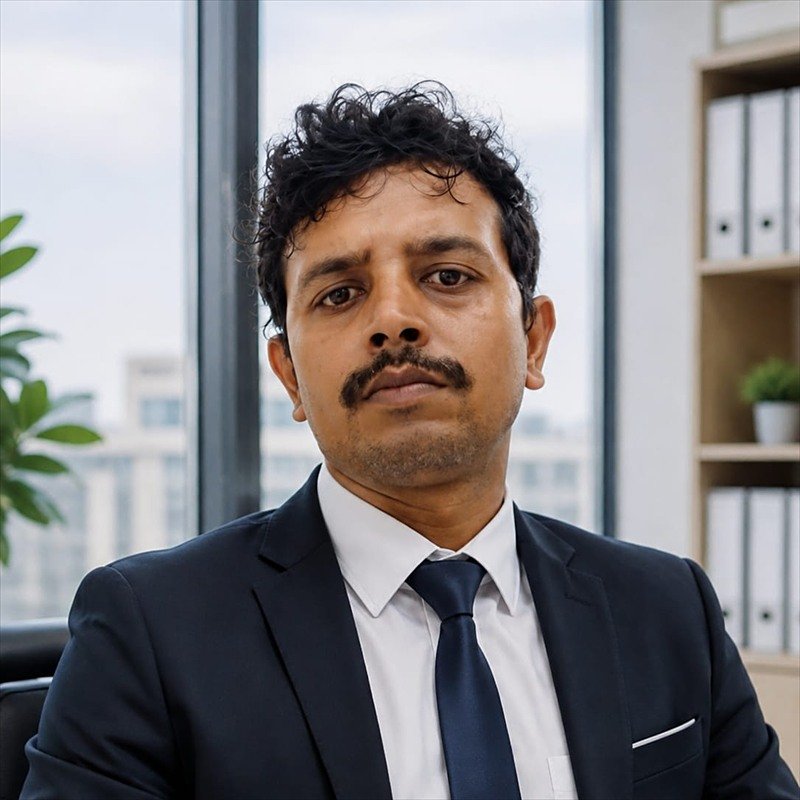
Our Founder
Vikram Kumar founded the Subhsarth Charitable Foundation and the Dirghayu Foundation on a simple conviction: that what most women in our districts lack is not ability or willingness to work, but capital and a fair chance to prove themselves.
He had watched capable women turned away by lenders who wanted collateral they did not have, and helped by schemes that gave once and never returned. Neither approach left a family any steadier a year later. The foundation was built to do the opposite — to back a woman’s existing skill with real money, and then stay long enough to see the business survive.
That conviction came from a plain observation. In almost every household he visited, there was already a woman who could do something well — stitch, cook, keep accounts in her head, run a shop counter better than the man standing behind it. What was missing was never the skill. It was the twenty or thirty thousand rupees to buy the machine, the stock and the confidence of a shop with her own name on it.
So the foundation does not begin by asking what a woman lacks. It begins by testing what she already knows, and then builds the business around that answer.
In His Own Approach
The examination is the part people question most, and it is the part he defends hardest. Charity that is handed out on recommendation, he argues, quietly becomes patronage — the woman who receives it owes somebody, and the woman with no one to speak for her never reaches the front of the queue. An assessment removes that. It is set on practical skill rather than schooling, so a woman who never finished school but has stitched for twenty years can outscore anyone in the room. Nobody has to ask a favour to be considered.
The second decision was to give capital instead of a loan. Micro-lending has lifted a great many families in Bihar and Maharashtra, but it has buried others under interest they could not clear in a bad season. A woman on this scheme takes on no debt at all. The equipment and the opening stock are hers outright from the first day, and if the business has a difficult month, nobody arrives at her door to collect.
The 20% profit share that begins after three months is the piece he is most often asked to justify. It is not a repayment and it is not a fee. It is what turns a fixed pot of money into a moving one: every woman who does well funds the next woman’s machine. It also keeps the foundation honest, because it only earns anything at all if the businesses it sets up are genuinely profitable. A scheme that hands out equipment and walks away has no reason to care whether the shop is still open in a year. This one cannot afford not to.
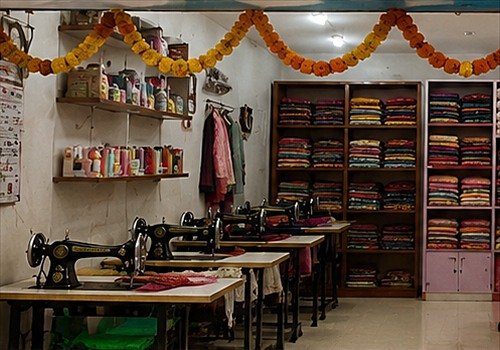
He measures the work by a single test, and it is a deliberately unflattering one: how many women no longer need the foundation at all. The Shilai Centre in Transport Nagar is the model — a shop that trades on real orders while training the next batch on the same floor, so the women learning there are learning inside a working business rather than a classroom. The intention is to open more centres on that pattern, trade by trade, district by district, and to keep every rupee traceable to a business with a name attached to it.
His Principles
Every part of the scheme — the examination, the set-up, the profit share — comes out of these three ideas.
Who gets funded is decided by an examination, not by who knows whom. A woman with no contacts and no schooling can still come first.
A woman is given a working business, not a donation to spend. The set-up is hers outright, with no interest, no collateral and no debt behind it.
The foundation owes her training and support. She returns 20% of profit after three months — which pays for the next woman, not for us.
Leadership
The foundation runs from two offices, and the standards that decide who is selected and what a set-up must include are set centrally so that a woman in Patna and a woman in Mumbai are judged the same way.
Leads the foundation from the Mumbai head office
Oversees the Patna office and the Shilai Centre
Sets the assessment and set-up standards for the scheme
Reviews where returned profit is reinvested
Get news about new centres, training batches and application dates.
Head Office: Yashwanth Shopping Centre, Road No. 7, Borivali East, Mumbai – 400066, Maharashtra
Patna Office: Kumharar, Thakurbari Road, Transport Nagar, Patna – 800026, Bihar
Monday - Friday
Saturday
Sunday






 Designed & Developed by Innovator Solution